# Frequently Asked Questions (FAQ)
## About Decision Desk HQ
Why should I choose Decision Desk HQ (DDHQ)?
Decision Desk HQ is the fastest, most reliable, and most transparent source for election data. We cover every election in the country — from local bond initiatives to presidential elections — no matter how local. DDHQ has an archive of county-level election results back to the year 2000, the deepest archive commercially available.
Additionally, DDHQ APIs are optimized for financial services use. In addition to speed of delivery, DDHQ provides point-in-time "Vote Drop" data optimized to help analysts back-test models and follow elections at the most granular level possible.
What businesses and news organizations trust Decision Desk HQ (DDHQ)?
We've partnered with NewsNation/The Hill, Ballotpedia, The 19th News, Robinhood and dozens of other local and regional news websites. Independent news organizations and streamers use our Election View System to provide quality coverage to their viewers. Our election API received more than 14 billion requests on election night 2024, and DDHQ interactive graphics received over 17 million views across all election night partners.
How fast does Decision Desk HQ (DDHQ) project elections compared to other outlets?
Decision Desk HQ race projections are based on statistical modeling, prioritizing accuracy over speed while delivering projections quickly enough to meet the demands of live news coverage and business solutions. In terms of speed, we were first to project the winner of the:
* [2016 Presidential election](https://x.com/DecisionDeskHQ/status/796229649344954368)
* [2020 Presidential election](https://x.com/DecisionDeskHQ/status/1324710866516905984)
* 2022 Congressional elections ([Senate](https://x.com/DecisionDeskHQ/status/1591616622510280704) and [House](https://x.com/DecisionDeskHQ/status/1592657104476962817))
* [2024 Presidential election](https://x.com/DecisionDeskHQ/status/1854046415372296440)
In the 2026 cycle, DDHQ projections consistently beat the Associated Press 79% of the time, by an average of 24 minutes and a median of 18 minutes.
DDHQ has a history of collecting results faster than its industry peers. While we do not share this data publicly, reach out and ask and we will share on a case-by-case basis.
## Election Results Data
Where are Decision Desk HQ's (DDHQ) election results data sourced from?
Decision Desk HQ data comes from an official state source. These sources are almost always the Secretary of State or the Department of Elections.
Decision Desk HQ election data is not modeled or imputed.
Is the election data independently collected?
Yes. Decision Desk HQ collects results independently rather than reselling a single wire feed.
Our reporting workflow combines three coordinated methods:
* **Automated data collection** — scripts run by developers alongside QA specialists at prescribed intervals.
* **Remote monitoring** — reporters assigned specific geographies, collecting from official websites, emails, and faxes.
* **In-person collection** — reporters assigned to specific geographies in person, uploading results via a proprietary web app.
Roughly 80% of all votes are processed via scraping or manual monitoring. 43 states allow for automated data collection and 41 states are mostly collected through automated processes.
Preparation to report on a race begins up to 12 months before election day.
How is the data ingested and de-duplicated?
All three collection methods feed Decision Desk HQ's Results Management Platform, designed to ingest the sources simultaneously, with checks in place to avoid double-counting or publishing "stale" data.
What states does Decision Desk HQ get live election results from?
Decision Desk HQ has election results from all 50 states and the District of Columbia.
Does Decision Desk HQ collect election data internationally?
Yes. Decision Desk HQ collects international election results on request.
How extensive is Decision Desk HQ's election archive?
Decision Desk HQ offers the most complete commercially available election data archive, with county-level results as early as 2000 and precinct-level results back to 2020.
Where do you get your early and absentee data from, and why is it different from what the state is showing?
All of DDHQ's early vote and absentee data is cross-referenced with a voter file. In the process, we may get differing counts/totals and/or lagged reporting compared with the official state site.
Are Decision Desk HQ methodologies published?
Yes. Decision Desk HQ values trust and transparency above all: we publish our methodologies, speak on the record about our projections, and keep cameras in our command center. Documentation for the API, embeds, and the Votes dashboard is provided to clients.
Our published methodologies are available here:
* [Polling Methodology](/polling-methodology)
* [2026 Congressional Forecast Methodology](/forecast-methodology/2026-congressional-forecast-methodology)
* [2026 Governor Forecast Methodology](/forecast-methodology/2026-governor-forecast-methodology)
Has Decision Desk HQ ever retracted a race projection?
Yes, and Decision Desk HQ publishes the list. A projection requires greater than 99.9999% confidence. Retractions are rare but do occur. When DDHQ retracts, it's done so publicly, through the same channels the projections were published — and every DDHQ retraction below links to our own statement, in our own words, at the time.
Since our founding, DDHQ has retracted four projections in federal or state-wide races:
* **MI presidential primary, 2016** — DDHQ projected Hillary Clinton; Bernie Sanders won, and DDHQ retracted and apologized the same night.
* **CA-21, 2018 general** — DDHQ and the Associated Press both projected David Valadao; T.J. Cox went on to win by 862 votes.
* **MO-1, 2020 Democratic primary** — mail-in ballots shifted the outcome to Cori Bush.
* **NJ-11, 2026 Democratic special primary** — DDHQ projected Tom Malinowski; Analilia Mejia overtook him on late Morris County returns.
DDHQ also retracted its projection in the 2025 Seattle mayoral race — one DDHQ competitor never projected it at all, because it is among the tens of thousands of contests only DDHQ covers.
Retractions are not unique to DDHQ. Nine retractions in national races have been publicly documented since 2016. The Associated Press accounts for six, DDHQ accounts for four, and CA-21 is the one shared:
| Race | Retracted by | Sources |
| ------------------------------- | ------------ | ----------------------------------------------------------------------------------------------------------------------------------------------------------------------------------------- |
| MI presidential primary, 2016 | DDHQ | [DDHQ on X](https://twitter.com/DecisionDeskHQ/status/707417584195350528) |
| CA-21, 2018 general | DDHQ and AP | [PBS/AP](https://www.pbs.org/newshour/politics/how-the-ap-calls-races-and-what-to-expect-on-election-night) · [DDHQ](https://decisiondeskhq.substack.com/p/race-call-retraction-in-ca-21) |
| MO-1, 2020 primary | DDHQ | [DDHQ on X](https://x.com/DecisionDeskHQ/status/1290860670083313664) |
| NJ-11, 2026 special primary | DDHQ | [DDHQ on X](https://x.com/DecisionDeskHQ/status/2019614645569372665) |
| TX-23, 2018 general | AP | [Spectrum News SA](https://spectrumlocalnews.com/tx/san-antonio/news/2018/11/07/ap-withdraws-hurd-call-in-texas-us-house-race) |
| NC-9, 2018 general | AP | [AP](https://apnews.com/article/16671b61ebc24e51afe63372d39f7bd4) |
| GA-7, 2020 primary | AP | [Washington Post](https://www.washingtonpost.com/politics/paloma/the-trailer/2020/06/11/the-trailer-how-politicians-could-exploit-a-slow-vote-count/5ee10ad0602ff12947e8974a/) |
| GA-13, 2020 primary | AP | [Washington Post](https://www.washingtonpost.com/politics/paloma/the-trailer/2020/06/11/the-trailer-how-politicians-could-exploit-a-slow-vote-count/5ee10ad0602ff12947e8974a/) |
| CA Senate special primary, 2022 | AP | [@AP\_RaceCalls](https://x.com/AP_RaceCalls/status/1534379539857559552) |
We are not a provider that never misses. DDHQ is the provider who covers every contest, projects it faster, corrects transparently, and hands you the receipts instead of hoping you don't ask.
## Polling
What kinds of polls does Decision Desk HQ collect?
Decision Desk HQ has a team of people who seek out and collect all publicly available polls that have political questions. Each poll is sourced to the original sponsor and we collect the associated poll memo, cross-tabs and top-lines where available. Polls must meet the minimum disclosure standards as laid out by The American Association for Public Opinion Research.
How many poll averages does Decision Desk HQ collect, and does DDHQ collect cross-tabs?
The number of poll averages we have varies and will only increase as we get closer to an election. Generally speaking, to create an average, we would prefer to have at least three and potentially up to ten polls to construct an average from, with variations based on the frequency of those polls. We can create averages for candidates, campaigns and issues.
For major national averages such as candidate approval, presidential approval and select policy issues, we will calculate averages for sub-cohorts such as ethnicity and gender.
See [Polling Methodology](/polling-methodology) for the full details.
## Forecast, Pulse & Prediction Markets
How do the Forecast and Election Pulse work?
A race projection requires a confidence level greater than 99.9%. Many financial services use cases can act on lower confidence earlier. The Decision Desk HQ Forecast (pre-election) and Election Pulse (election-night live forecast) quantify the probability of each race outcome at any point in time. The Pulse begins from the pre-election forecast and adjusts continuously based on reported vote patterns and the characteristics of the remaining uncounted ballots.
How accurate is the Decision Desk HQ forecast, and how does it work?
The Decision Desk HQ forecast is based on a calibrated combination of past election results, race-level polling, markets, and the national environment. When predicting the likely outcome for a given race, it considers how Democrats and Republicans have fared there in the past, how the candidates are polling, and how the national environment has shifted since the previous election.
While the forecast has evolved over the years, it has been repeatedly submitted for academic peer review:
* DDHQ's 2020 Presidential and Congressional forecast was accepted into the [Harvard Data Science Review in the fall of 2020](https://hdsr.mitpress.mit.edu/pub/gach7e59/release/3).
* In 2022, DDHQ published a paper on how turnout is modeled during a live election in the [Harvard Data Science Review in the fall of 2022](https://hdsr.mitpress.mit.edu/pub/ftwzgrij/release/4).
* Most recently, DDHQ published a paper on how to model the eventual winner of an election with live election data in the [Harvard Data Science Review in the fall of 2024](https://hdsr.mitpress.mit.edu/pub/zr6hjsfl/release/1).
In 2024, the [New York Times identified Decision Desk HQ's forecast](https://www.nytimes.com/2024/11/23/us/elections/election-forecasts-predictions.html) as correctly projecting the winner in 6 of 7 swing states, that Republicans would win control of both chambers of Congress, and correctly forecasting Donald Trump the winner of the Presidency. DDHQ's forecast was more accurate than the forecasts from Nate Silver's Silver Bulletin, FiveThirtyEight and The Economist.
See [2026 Congressional Forecast Methodology](/forecast-methodology/2026-congressional-forecast-methodology) and [2026 Governor Forecast Methodology](/forecast-methodology/2026-governor-forecast-methodology) for the full details.
The 2026 forecast utilizes prediction market data. Where is it sourced from, and is DDHQ compensated or sponsored for using that data in its forecast?
Market probabilities are sourced from Polymarket and Kalshi exchanges. DDHQ is not paid or sponsored by Polymarket or Kalshi to use prediction market data in its forecast.
## Using Votes
How many races can I follow at once?
Free users of Votes can create one watchlist that includes up to 5 races. Votes Pro subscribers can create and follow an unlimited number of races.
How do I add races to or remove races from a watchlist?
To add a race to your watchlist, click the star icon located across from a race title and then select the watchlist you'd like to add the race to.
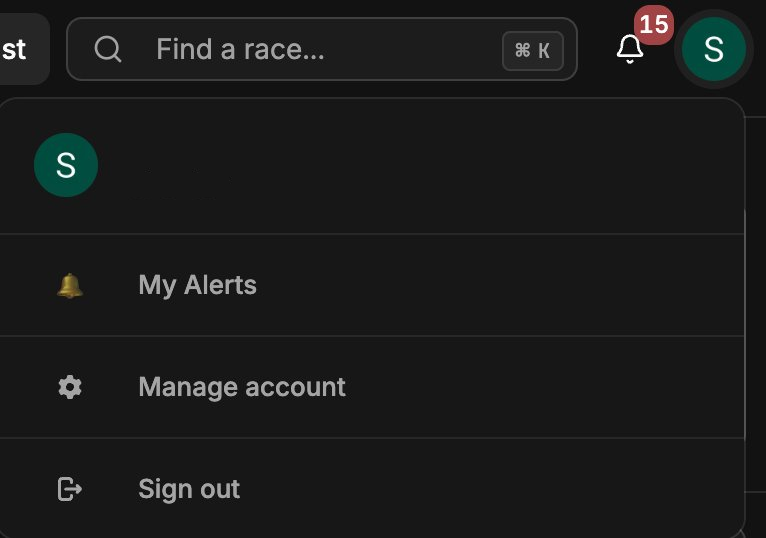
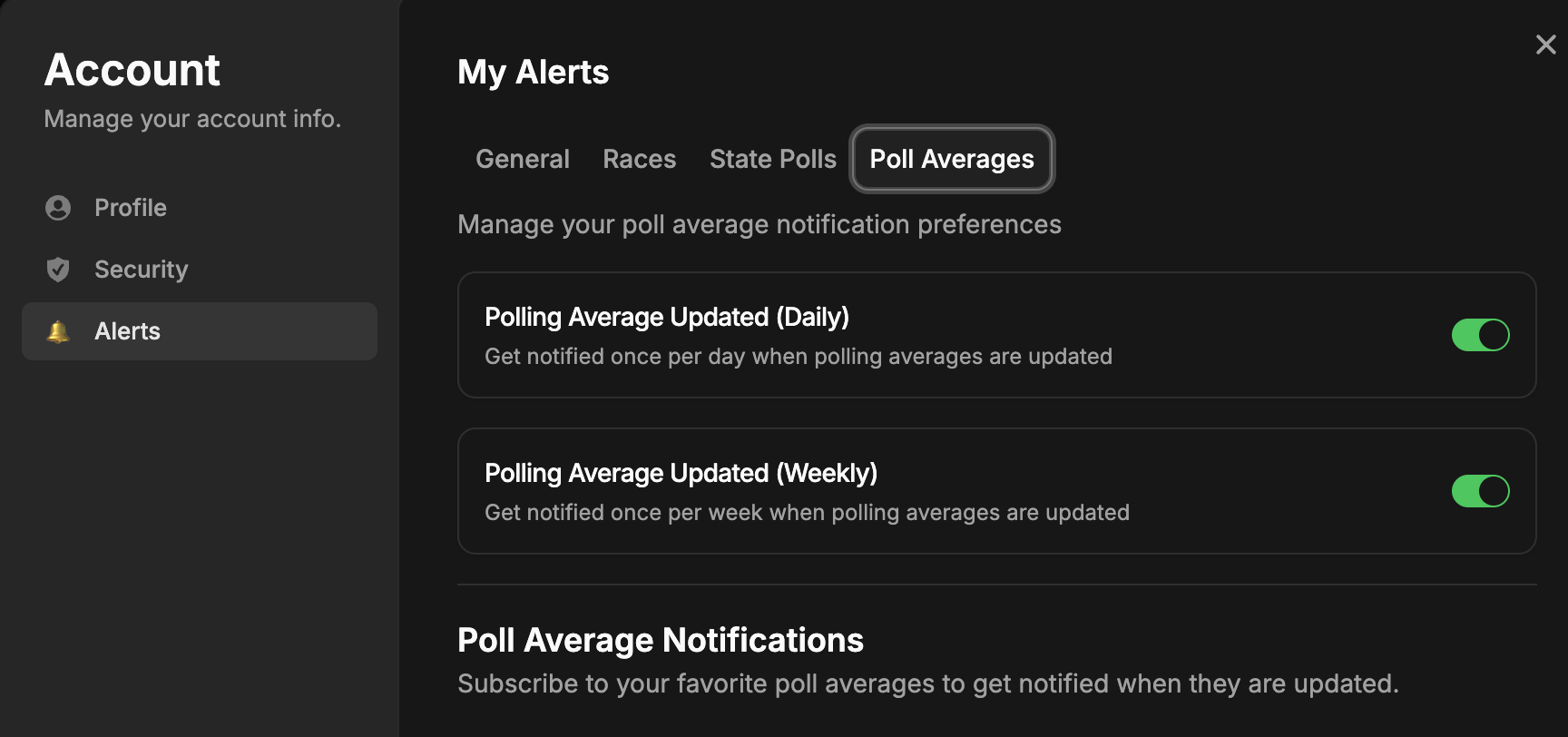
How do I manage all of my alerts at once?
In your profile, you'll find a section called 'My Alerts' where you can manage all of the alerts you've signed up for.
Step 1: Go to your account icon in the upper right corner of your screen
Step 2: Select the alerts you have in your menu
How many races can I download?
10 per day
How far back does your race archive go?
Our race archive dates back to 2000 and in some states even further back. Free Votes users can only access races back to 2020.
## Votes Pro
How long is my Votes Pro subscription good for?
December 31, 2026. We'll have information on renewal options after the elections in November.
What's Decision View?
Decision View is a unique feature of Votes Pro that enables you to customize your election night viewing experience. You can pick the races and data points you want to track on one screen so you don't have to click between individual race pages in Votes. Never miss an important vote drop, prediction market movement, or race projection because you were on a different screen.
What is Vote Drop History?
It's not enough to know that the overall vote totals have changed — you need to know where the latest votes came from and which candidate benefited or was hurt by them. With Vote Drop History, you can spot trends or know when a race is close to being projected because you have the most up-to-date and granular understanding of the vote count.
## Votes Broadcast
What is Votes Broadcast?
Votes Broadcast is a version of Votes optimized for streamers and broadcast television. It has all the same functionality and election data as Votes but in a format designed to be used on-stream or on-air by a host or anchor. The maps, candidate photos, graphs and visuals are designed to be shown on-stream as a "shared screen," or used in a studio setting as a touchscreen application. Reach out to if you want to discuss licensing.
## Account & Privacy
Do you share my data with 3rd parties?
We do not sell your Personal Information and will not do so in the future without providing you with notice and an opportunity exercise your rights under applicable law.
## Support & Feedback
I've encountered an error or bug. Who can I contact to fix it?
Good catch. We would appreciate it if you could reach out to and describe the error you encountered.
Can I request new features?
We would love that! If you have ideas for improving this platform, please email with specific details on what you want to see.
DDHQ seems like an amazing place to work — can I work with you?
We have a variety of seasonal opportunities and are always looking for the best talent. Find out more here:
# Polling Methodology
Decision Desk HQ is committed to providing accurate, reliable, and comprehensive poll averages that reflect the current state of public opinion, races for elective office, and ballot initiative efforts. Our methodology, detailed below, is designed to ensure that our poll averages consider all available data and time trends, while being methodologically sound and consistent over time.
{% hint style="info" %}
**Quick reference:** A poll must meet [AAPOR disclosure standards](https://aapor.org/standards-and-ethics/disclosure-standards/#1667933142550-55785157-2071) — methodology, field dates, and sample size disclosed — to be included. We need at least 2 qualifying polls to publish an average for a race, and once a race has 15 or more polls, our estimate is driven entirely by the cubic-spline time trend rather than the flatter weighted-average blend described below.
{% endhint %}
### Sourcing
Our team carefully reviews and averages these polls using a straightforward methodology, ensuring that our polling averages reflect a balanced, up-to-date snapshot of public opinion. Within each average, you can find a specific point in time to compare how things have changed or view any poll included within that average. See the [DDHQ Dictionary](/ddhq-dictionary) for a plain-language definition of a polling average.
Polls featured in our averages must meet AAPOR standards and state their methodology, field dates, and sample size. Responses must come from real people - not synthetic or AI-generated respondents - and results must not be adjusted to fit the pollster's expectations about the race. We require a firm's principal members to be publicly identified, and we only add polls that come directly from pollster, sponsor, news, or campaign websites; when anything is missing or unclear, we confirm by email.
Some polls are kept in our polling vault for historical reference but excluded from our averages when they don't meet the criteria above — for example, polls from The Public Sentiment Institute.
### Our Approach
Decision Desk HQ has averaged polls since the 2018 midterm election cycle, and over time, we've refined our methodology to focus on simplicity, interpretability, and accuracy. It's easy to get carried away with sophisticated statistical approaches that mine large amounts of historical polling data for every possible variable, but, as has been [shown consistently](https://sites.stat.columbia.edu/gelman/research/published/polling-errors.pdf), keeping it simple pays dividends when averaging polls.
### How We Build Our Averages
Most approaches to averaging polls – though not ours – involve taking a vendor's base poll and making substantial changes to the results. This typically includes work such as:
* Time-weighing polls
* Adjusting polls for house effects and quality of polling
* Weighing different populations (e.g., likely voters, registered voters) differently
* Weighting by sample size
* Treating outliers
After this, the results are averaged using one of an array of methods, e.g., a moving average, an exponentially weighted average, or more complex approaches.
These approaches are all valid, but they also introduce many subjective decisions about how to treat certain types of data, and these decisions are sometimes made without enough data to justify one decision over another.
Our goal is to provide a straightforward, consumer-facing average that accurately reflects the current state of polling, is easy to interpret, and is not overly sensitive to recent news events. If a poll [meets the standards set by the American Association of Public Opinion Research (AAPOR)](https://aapor.org/standards-and-ethics/disclosure-standards/#1667933142550-55785157-2071) and releases its methodology, field dates, and sample size, we include it in our average. The only factors that affect how DDHQ incorporates a poll into its analysis are its recency and whether it is an internal poll—meaning it was commissioned by a candidate or their campaign committee. Additionally, at least 2 polls are required for us to publish an average for any race.
#### How We Handle Recency
If a race has too few polls to reliably estimate time trends, we use a flatter weighted-average approach, giving older polls a bit more influence than they would in a spline-based method. This approach reduces variance by stabilizing estimates in data-sparse environments, but it comes at the cost of potential bias, as older polls may be less representative of the race's current dynamics. Our analysis has determined that this bias-variance tradeoff is preferential for low polling volume races–for instance, in US House races, we found no indication that polls coming earlier in the cycle are less accurate than those coming later.
As the polling volume increases and we begin to impute time trends, we blend an adjusted cubic spline into our weighted average, gradually increasing its weight. When there is sufficient polling volume in a race to strongly impute time trends (15 or more polls), the weighted average is no longer blended into the estimate. A cubic spline is a third-degree piecewise polynomial function that allows for smooth interpolation between data points. It eliminates the possibility of any sudden deviation or break from earlier results. We fit a new spline every day. The cubic spline for a given day is based only on polls conducted beginning on or before that day.
#### How We Handle Internal Polls
For horse race polling, we average internal polls. The first internal poll from a candidate or campaign committee is averaged into our average as normal, but any additional internals from the same candidate are averaged with that poll rather than entered as a new poll. This limits a campaign's ability to “flood” the average with polls while still reflecting the data available.
#### Crosstab Averaging
We collect crosstabs from all available polls that meet AAPOR standards and apply a minimum sample size threshold for inclusion. Due to the nature of crosstabs (smaller sample sizes, infrequency of release), averages can be more volatile in the short term.
The advantages of this approach are that it refrains from what has become, for many, a borderline-forecasting function while delivering results in line with those of more sophisticated approaches. All publicly available polls will be included in the Decision Desk HQ polling database. We provide averages that capture as close to a complete picture of the electorate as possible.
# Forecast Methodology
How DDHQ forecasts the 2026 congressional and gubernatorial elections
DDHQ publishes two probabilistic election forecasts for the 2026 cycle. Both apply the same three-layer blending architecture — structural fundamentals, aggregate public polling, and prediction market prices — adapted to the data available for each office.
| Forecast | Races covered |
| -------------------------------------------------------------------------------------------------------- | ----------------------------------- |
| [2026 Congressional Forecast Methodology](/forecast-methodology/2026-congressional-forecast-methodology) | U.S. House and Senate |
| [2026 Governor Forecast Methodology](/forecast-methodology/2026-governor-forecast-methodology) | 36 governorships on the 2026 ballot |
Each page documents its own data sources, model specification, probability estimation, seat-distribution simulation, and limitations.
# 2026 Congressional Forecast Methodology
A Quantitative Framework for Forecasting 2026 U.S. Congressional Elections
Methodology Overview
2026 Election Cycle | U.S. House and Senate
## 1. Introduction
We describe the statistical methodology underlying a probabilistic forecasting system designed to estimate the likelihood of Republican and Democratic victory for each US House and Senate race in 2026. The model integrates three distinct classes of information: structural fundamentals derived from historical electoral and financial data, aggregate public polling, and aggregated prediction market information. The outputs are race-level win probabilities, qualitative competitive ratings, and seat-distribution simulations for each chamber.
The forecasting framework is motivated by a long-standing literature in political science demonstrating that election outcomes are meaningfully predictable from both structural conditions and contemporaneous public opinion measures. The present approach draws on this tradition while incorporating advances in ensemble machine learning and market-based inference to produce estimates that are robust to the limitations of any single data source.
## 2. Data Sources and Variable Construction
The model draws on four primary data sources: a historical training dataset spanning multiple election cycles, Federal Election Commission (FEC) campaign finance records, the DDHQ live polling database, and prediction market price feeds.
### 2.1 Historical Training Data
The core training dataset is assembled at the race level for contested general elections from 2016 through 2024. Each observation encodes the two-party vote margin, alongside a set of structural predictors.
### 2.2 Partisan Baseline
Public opinion today is sharply polarized along partisan lines, and political scientists widely recognize baseline partisanship as among the most reliable predictors of future electoral outcomes \[1]\[2]. Our model leverages this insight: the prior electoral lean of the district or state. For House races, this is operationalized as the most recent presidential margin adjusted for national environmental swing. For Senate races, the analogous measure is the adjusted prior presidential margin within the state. These variables capture the underlying partisan composition of the electorate and serve as a strong prior on competitiveness, particularly in races where polling is sparse or absent.
### 2.3 National Political Environment
The political science literature widely recognizes the generic ballot as a strong predictor for House election outcomes \[3]\[4]. A single continuous variable summarizes the broader electoral environment in a given cycle, encoded by the DDHQ generic ballot polling average. The average is smoothed via a Kalman filter to prevent transient polling fluctuations from unduly influencing the forecast outlook. The resulting smoothed average allows the model to adjust all race-level predictions in a consistent direction when national forces favor one party, reflecting the well-documented tendency for election outcomes across individual districts to co-move with national partisan tides.
### 2.4 Campaign Finance
Fundraising data are drawn from the Federal Election Commission and supplemented with outside expenditure records. The model constructs a normalized receipts measure for each candidate that incorporates direct campaign receipts, coordinated outside support, and offsetting outside opposition spending:
$$
F\_{\text{norm}} = R\_{\text{Receipt}} + \text{Support}*{\text{Outside}} - \text{Opposition}*{\text{outside}}
$$
The resulting variable captures the net financial advantage accruing to each party's candidate in a given race. In the absence of available finance data for a given race, the variable is imputed to the sample mean, preventing data gaps from distorting predictions for unpolled or under-reported contests.
### 2.5 Incumbency and Structural Covariates
For Senate races, incumbency status is included as a categorical predictor. Incumbency is well-established in the political science literature as having historically conferred a meaningful electoral advantage, particularly in lower-information environments \[5]\[6]. An additional interaction variable encodes the combination of the incumbent president's party and cycle type (midterm versus presidential year), capturing the consistent pattern by which the party holding the White House tends to underperform in midterm elections relative to presidential election years.
## 3. Model Specification and Estimation
### 3.1 Training Architecture
The model is trained separately for House and Senate races, and separately for each target cycle using a strict temporal holdout: all observations from prior cycles are used for training, while the target cycle constitutes the test set. This design prevents data leakage and produces out-of-sample forecasts that are directly analogous to real-world conditions in which the future is unobserved at the time of prediction.
Continuous predictors are standardized prior to model fitting using z-score normalization estimated on the training set.
### 3.2 Ensemble Approach
Point predictions of the two-party margin are generated by an ensemble of complementary algorithms. The three algorithms differ substantially in their inductive biases: Ridge regression imposes linear structure with L2 regularization to prevent overfitting to small historical samples; Random Forest aggregates many shallow decision trees to capture nonlinear interactions without explicit feature engineering; XGBoost employs sequential boosting of residual errors to achieve low bias under controlled regularization.
The fundamentals-driven ensemble prediction MF for race i is computed as the average margin m predicted by each model n :
$$
M\_F(i) = \frac{1}{N} \sum\_{n}^{N} m\_n
$$
Averaging across models with diverse error structures reduces variance relative to any single estimator, a property that is especially valuable given the limited size of the historical training sample. The ensemble's aggregate prediction serves as the fundamentals-based margin estimate for each race.
## 4. Polling Integration
Where public polling is available for a given race, the fundamentals-based margin estimate is blended with a polling average to produce a combined model margin. Polling data are sourced from DDHQ’s live database and aggregated to a race-level average as of the most recent available date. The polling weight assigned to a given race is a linear function of the number of available polls n, scaled to a maximum weight at a ceiling of n₀ polls:
$$
w\_{\text{poll}} = w\_{\text{max}} \min\left(1, \frac{n}{n\_0}\right)
$$
Races with no polling receive a weight of zero, defaulting to the pure fundamentals prediction. The combined final model margin m for race i is then computed as:
$$
m(i) = \left\[1 - w\_{\text{poll}}(i)\right] M\_F(i) + w\_{\text{poll}}(i), p\_{\text{poll}}(i)
$$
This framework ensures that heavily-polled races are more responsive to public opinion data, while thinly-polled contests remain anchored to the structural prior.
## 5. Probability Estimation
Win probabilities are derived from the combined model margin using the normal cumulative distribution function. Under this specification, the Republican win probability PR(i) for race i based on polling and fundamentals is:
$$
P\_R(i) = \Phi\left(\frac{m(i)}{\sigma}\right)
$$
where Φ(·) denotes the standard normal CDF and σ is the residual standard deviation of the model, estimated empirically from historical out-of-sample forecast errors. This formulation is consistent with standard probit-type frameworks in the political science literature and produces well-calibrated probability estimates across a wide range of competitive conditions.
Races are subsequently assigned to a seven-category competitive rating scale ranging from Safe Democratic through Safe Republican, with intermediate categories of Likely, Lean, and Toss-Up. Rating thresholds are applied to the win probability output and are designed to match the conventional qualitative classifications used in political analysis.
## 6. Prediction Market Integration
A third input layer incorporates prices from prediction markets, which aggregate the probabilistic assessments of financially-motivated participants. Prediction markets have demonstrated competitive accuracy relative to polling-based models in a number of forecasting studies \[7]\[8], and their inclusion provides an independent signal that may incorporate information not yet reflected in public polling or structural variables.
Market-implied win probabilities are sourced from a market price feed and matched to corresponding race. The effective trading volume V associated with each market, aggregated over multiple prediction exchanges, determines the weight assigned to the market signal. A race must clear a minimum effective volume threshold Vmin, with weight scaling up to a maximum of wmax as effective volume V approaches a ceiling V₀ :
$$
w\_{\text{mkt}}(V) = w\_{\text{max}} \sqrt{\frac{V}{V\_0}} \quad \text{if } V \geq V\_{\text{min}}, \text{ else } 0
$$
The final win probability for race i is computed as a weighted average of the model-plus-polling baseline probability PR and the market-implied probability Pmkt:
$$
P\_F(i) = \left(1 - w\_{\text{mkt}}\right) P\_R(i) + w\_{\text{mkt}} P\_{\text{mkt}}
$$
This three-layer blending architecture - fundamentals, polling, and markets - ensures that each input class contributes in proportion to the strength of the available signal, rather than treating all data sources as equally informative regardless of coverage or depth.
Market probabilities are sourced from Polymarket and Kalshi exchanges. DDHQ is not paid or sponsored by Polymarket or Kalshi to use prediction market data in its forecast. See the [DDHQ Dictionary](/ddhq-dictionary) for a plain-language definition of trading volume.
## 7. Seat Distribution Simulation
To estimate the probability that each party controls the chamber following the election, the model generates Monte Carlo simulations for each individual race outcome. Each simulation draws a correlated vector of race outcomes from a single-factor probit model, in which a shared national factor η induces positive correlation across all races. For race i in simulation N, the latent outcome is:
$$
y\_i^N = \mu\left(P\_F(i)\right) + \lambda\eta + \epsilon\_i, \quad \epsilon\_i \sim N(0, \sigma^2)
$$
where λ governs the strength of cross-race correlation and η is a shared draw from the standard normal distribution. The Republican candidate wins race i in simulation N if yiN > 0. Uncontested races—defined as those in which one party has no viable opponent—are excluded from the probabilistic model and assigned deterministically to the appropriate party. The distribution of simulated seat outcomes yields chamber-level majority probabilities, expected seat margins, and full distributional uncertainty intervals.
## 8. Limitations and Caveats
Several limitations of the present framework merit explicit acknowledgment. First, the historical training sample available to any election forecast is relatively small by machine learning standards: congressional elections only occur every 2 years, and each cycle provides fewer than 500 additional observations, introducing a degree of irreducible estimation uncertainty. The regularized ensemble approach partially mitigates this concern by reducing overfitting, but it does not eliminate it.
Second, the model assumes that the structural relationships observed in past cycles are stable over time. To the extent that the 2026 electoral environment reflects genuinely novel conditions—whether in candidate quality, issue salience, or voter behavior—the model may systematically under- or overestimate the magnitude of partisan shifts. Third, polling averages and prediction market prices are themselves imperfect signals subject to systematic biases, late-breaking information, and coverage gaps, particularly in lower-profile House races where public polling is sparse or nonexistent. Prediction markets in particular are very recent innovations, and are rapidly evolving. Their forecast integration will surely continue to develop and evolve over the coming years.
Finally, all probabilistic forecasts should be interpreted as estimates under uncertainty rather than definitive predictions. The competitive ratings and win probabilities reported by this system represent the model's best assessment of the likely range of outcomes given available information at a point in time; they will be updated as new data are incorporated across the election cycle.
## References
\[1] Bartels, L. M. (2000). Partisanship and voting behavior, 1952–1996. American Journal of Political Science, 44(1), 35–50.
\[2] Abramowitz, A. I., & Webster, S. W. (2016). The rise of negative partisanship and the nationalization of U.S. elections in the 21st century. Electoral Studies, 41, 12–22.
\[3] Bafumi, J., Erikson, R. S., & Wlezien, C. (2010). Balancing, generic polls and midterm congressional elections. Journal of Politics, 72(3), 705–719.
\[4] Bafumi, J., Erikson, R. S., & Wlezien, C. (2010). Forecasting house seats from generic congressional polls: The 2010 midterm election. PS: Political Science & Politics, 43(4), 633–636.
\[5] Gelman, A., & King, G. (1990). Estimating incumbency advantage without bias. American Journal of Political Science, 34(4), 1142–1164.
\[6] Ansolabehere, S., & Snyder, J. M. (2002). The incumbency advantage in U.S. elections: An analysis of state and federal offices, 1942–2000. Election Law Journal, 1(3), 315–338.
\[7] Atanasov, P. D., Witkowski, J., Mellers, B., & Tetlock, P. E. (2025). Crowd prediction systems: Markets, polls, and elite forecasters. International Journal of Forecasting, 41(2), 580–595.
\[8] Berg, J. E., Nelson, F. D., & Rietz, T. A. (2008). Prediction market accuracy in the long run. International Journal of Forecasting, 24(2), 285–300.
# 2026 Governor Forecast Methodology
A Quantitative Framework for Forecasting 2026 U.S. Gubernatorial Elections
## 1. Introduction
We describe the statistical methodology underlying a probabilistic forecasting system designed to estimate the likelihood of a Republican or Democratic victory in each of the 36 gubernatorial races on the 2026 ballot. The model integrates three distinct classes of information: structural fundamentals derived from historical electoral data, aggregate public polling, and prediction market prices. The outputs are race-level win probabilities, qualitative competitive ratings, and a seat-distribution simulation across all gubernatorial contests.
The forecasting framework applies the same three-layer blending architecture used in the companion House and Senate models, adapted to the particular data constraints of gubernatorial elections: a smaller number of contests per cycle, the absence of a campaign-finance signal with coverage comparable to that available for federal races, and a state executive office whose electoral behavior does not always track federal partisan trends as closely as House and Senate races do.
## 2. Data Sources and Variable Construction
The model draws on three primary data sources: a historical training dataset spanning multiple gubernatorial election cycles, the DDHQ live polling database, and prediction market price feeds. Unlike the companion House and Senate models, this model does not currently incorporate a campaign-finance covariate, reflecting the comparatively limited and less standardized financial disclosure data available for state executive races (see Section 8).
### 2.1 Historical Training Data
The core training dataset is assembled at the race level for contested gubernatorial general elections from 2016 through 2024. Each observation encodes the two-party vote margin alongside a set of structural predictors. Gubernatorial elections occur on a staggered schedule across states, and roughly three dozen contests are held in any given cycle. This is a substantially smaller sample than is available for House races, and is comparable in scale to the sample available for the Senate. That smaller sample constrains both the complexity of the model that can be reliably estimated and the granularity of the historical back-testing described in Section 5.
### 2.2 Partisan Baseline
As with the companion House and Senate models, the model leverages the well-documented reliability of baseline partisanship as a predictor of electoral outcomes. For gubernatorial races, this is operationalized as the state's most recent presidential margin, adjusted for the national environment described in Section 2.3. Unlike the House and Senate models, the prior gubernatorial result itself is not used as an independent predictor. Outgoing governors' personal margins are frequently idiosyncratic, reflecting name recognition, tenure-specific circumstances, or a personal brand that is not transferable to a successor, and once incumbency is accounted for separately (Section 2.4), the prior result does not improve on presidential lean as a measure of a state's underlying partisan composition.
### 2.3 National Political Environment
In all of our models, the generic ballot is a single continuous variable that summarizes the broader electoral environment in a given cycle; it is encoded by the DDHQ generic congressional ballot polling average. The average is smoothed via a Kalman filter to prevent transient polling fluctuations from unduly influencing the forecast outlook. The resulting smoothed average is used to adjust each race's partisan baseline (Section 2.2) to reflect the current national mood, allowing the model to shift all race-level predictions in a consistent direction when national forces favor one party.
### 2.4 Incumbency
Rather than including incumbency as a fitted categorical predictor, the model estimates a direct, non-parametric incumbency adjustment: the median historical gap between a race's actual margin and its partisan baseline, computed separately for Republican-held, Democratic-held, and open seats, using only cycles prior to the target year. The median is used in place of the mean because a small number of outlier gubernatorial races — most notably several instances of unusually popular incumbent governors substantially outperforming their state's presidential lean — would otherwise exert disproportionate influence on the estimated effect, given how few gubernatorial contests are available for estimation within any single incumbency category.
### 2.5 Candidate Quality (WAR)
A supplementary candidate-quality adjustment, constructed using the same methodology applied to the companion Senate and House models, is added to the fundamentals estimate for each race. This adjustment captures candidate-specific factors, primarily previous electoral over- or underperformance.
## 3. Model Specification and Estimation
### 3.1 Training Architecture
The model is trained using a strict temporal holdout: for any given target cycle, the incumbency and candidate-quality adjustments described above are estimated only from cycles strictly prior to that year. This design prevents data leakage and produces out-of-sample estimates that mirror real-world conditions, in which the future is unobserved at the time of prediction.
### 3.2 Fundamentals Estimation
Unlike the ensemble machine-learning approach used in the companion House and Senate models, the gubernatorial fundamentals estimate is constructed as a direct sum of its component parts, rather than as the output of a fitted statistical or machine-learning model. The fundamentals-driven estimate $$M\_F$$ for race i is:
$$
M\_F(i) = \text{Baseline}(i) + \text{Incumbency}(i) + \text{Quality}(i)
$$
This specification reflects the more limited historical sample available for gubernatorial races. Flexible, tree-based ensemble methods, of the kind used in the House and Senate models, tend to compress predictions toward the center of the training distribution, a form of shrinkage that is especially costly for races with few or no close historical analogues. An explicit additive specification instead preserves the full range of the underlying baseline and incumbency signals, at the cost of forgoing any interaction effects a fitted model might otherwise capture. Given the comparatively small number of available observations, this tradeoff is judged to favor the additive approach for state executive races.
## 4. Polling Integration
Where public polling is available for a given race, the fundamentals-based margin estimate is blended with a polling average to produce a combined model margin. Polling data are sourced from DDHQ's live database and aggregated to a race-level average as of the most recent available date; for races without an official DDHQ polling average, that average is computed directly from individual published polls. The polling weight assigned to a given race is a linear function of the number of available polls n, scaled to a maximum weight $$w\_{\text{max}}$$ at a ceiling of $$n\_0$$ polls:
$$
w\_{\text{poll}} = w\_{\text{max}} \cdot \min\left(1, \frac{n}{n\_0}\right)
$$
Races with no polling receive a weight of zero, defaulting to the pure fundamentals prediction. The combined model margin m for race i is then computed as:
$$
m(i) = \left\[1 - w\_{\text{poll}}(i)\right] \cdot M\_F(i) + w\_{\text{poll}}(i) \cdot p\_{\text{poll}}(i)
$$
This framework ensures that heavily polled races are more responsive to public opinion data, while thinly polled contests remain anchored to the structural prior.
## 5. Probability Estimation
Win probabilities are derived from the combined model margin using the normal cumulative distribution function. Under this specification, the Republican win probability $$P\_R(i)$$ for race i based on polling and fundamentals is:
$$
P\_R(i) = \Phi\left(\frac{m(i)}{\sigma}\right)
$$
where Φ(·) denotes the standard normal CDF and σ is the residual standard deviation of the fundamentals estimate, derived empirically from out-of-sample forecast errors across the three most recently completed gubernatorial cycles (2020, 2022, and 2024) and scaled by a fixed multiplier to avoid overconfidence in the resulting probabilities. Cycles prior to 2018 are excluded from this back-test, as too few gubernatorial races preceded them to reliably estimate the incumbency adjustment described in Section 2.4.
Races are subsequently assigned to a seven-category competitive rating scale ranging from Safe Democratic through Safe Republican, with intermediate categories of Likely, Lean, and Toss-Up. Rating thresholds are applied to the win probability output and are designed to match the conventional qualitative classifications used in political analysis.
## 6. Prediction Market Integration
A third input layer incorporates prices from prediction markets, which aggregate the probabilistic assessments of financially motivated participants. The inclusion of prediction markets provides an independent signal that may incorporate information not yet reflected in public polling or structural variables.
Market-implied win probabilities are sourced from a market price feed, aggregated across the Polymarket and Kalshi exchanges, and matched to the corresponding race. Prices are clipped to a fixed range near the boundaries prior to use, to prevent a single extreme or thinly traded quote from dominating the blend. The effective trading volume V associated with each market, aggregated across exchanges, determines the weight assigned to the market signal. A race must clear a minimum effective volume threshold $$V\_{\text{min}}$$, with weight scaling up to a maximum $$w\_{\text{max}}$$ as effective volume approaches a ceiling $$V\_0$$:
$$
w\_{\text{mkt}}(V) = w\_{\text{max}} \cdot \sqrt{\frac{V}{V\_0}} \quad \text{if } V \geq V\_{\text{min}}, \text{ else } 0
$$
Rather than blending market and model probabilities directly, the market price is first converted to an implied margin using the same residual scale σ described in Section 5, and blended with the fundamentals-and-polling margin in that common unit:
$$
M\_{\text{mkt}}(i) = \sigma \cdot \Phi^{-1}\left(\tilde{p}\_{\text{mkt}}(i)\right)
$$
$$
m\_{\text{final}}(i) = \left\[1 - w\_{\text{mkt}}\right] \cdot m(i) + w\_{\text{mkt}} \cdot M\_{\text{mkt}}(i)
$$
The final win probability for race i is then computed once, from this fully blended margin:
$$
P\_F(i) = \Phi\left(\frac{m\_{\text{final}}(i)}{\sigma}\right)
$$
This three-layer blending architecture — fundamentals, polling, and markets — ensures that each input class contributes in proportion to the strength of the available signal, rather than treating all data sources as equally informative regardless of coverage or depth.
Market probabilities are sourced from the Polymarket and Kalshi exchanges. DDHQ is not paid or sponsored by Polymarket or Kalshi to use prediction market data in its forecast.
## 7. Seat Distribution Simulation
To estimate the probability that each party controls a majority of the 36 governorships on the 2026 ballot, the model generates one million Monte Carlo simulations of the full set of race outcomes. Each simulation draws a correlated vector of race outcomes from a single-factor probit model, in which a shared national factor η induces positive correlation across all races. For race i in simulation N, the latent outcome is:
$$
y\_i^N = c \cdot \left\[\Phi^{-1}\left(P\_F(i)\right) + \lambda \cdot \eta\right] + \epsilon\_i, \quad \epsilon\_i \sim N(0,1)
$$
where λ governs the strength of cross-race correlation, η is a shared draw from the standard normal distribution common to every race within a given simulation, and c is a scaling constant chosen so that each race's marginal win probability, averaged across simulations, continues to match $$P\_F(i)$$. The Republican candidate wins race i in simulation N if $$y\_i^N > 0$$.
The distribution of simulated outcomes yields the probability of a Republican or Democratic majority, the expected and median number of governorships held by each party, and full distributional uncertainty intervals. The simulation output additionally supports race-by-race correlation analysis and identification of the tipping-point race most likely to decide the majority in any given simulation, alongside sample full-map draws for scenario exploration.
## 8. Limitations and Caveats
First, the historical training sample available for gubernatorial elections is smaller than for House races and comparable to the Senate: roughly three dozen contests occur in any given cycle, and gubernatorial elections prior to 2018 are excluded from back-testing entirely due to an insufficient number of preceding observations. This introduces a meaningfully greater degree of irreducible estimation uncertainty than in the companion House model, and is the principal reason the fundamentals estimate is specified additively rather than through a fitted ensemble (Section 3.2).
Second, and unlike the companion House and Senate models, the gubernatorial fundamentals estimate does not currently incorporate a campaign-finance covariate. State-level campaign-finance disclosure is less standardized and less consistently available than federal FEC filings, and a comparable normalized receipts measure has not yet been constructed for gubernatorial candidates.
Third, the model assumes that the structural relationships observed in past cycles are stable over time. To the extent that the 2026 electoral environment reflects novel conditions, whether in candidate quality, issue salience, or voter behavior, the model may systematically under- or overestimate the magnitude of partisan shifts.
Fourth, polling averages and prediction market prices are themselves imperfect signals subject to systematic biases, late-breaking information, and coverage gaps, particularly in lower-profile gubernatorial races where public polling and market liquidity are sparse. Prediction markets in particular are a very recent innovation and are evolving rapidly; their integration into election forecasts will continue to develop over the coming years.
Finally, all probabilistic forecasts should be interpreted as estimates under uncertainty rather than definitive predictions. The competitive ratings and win probabilities reported by this system represent the model's best assessment of the likely range of outcomes given available information at a point in time; they will be updated as new data are incorporated across the election cycle.
# DDHQ Dictionary
Plain-language definitions of the terms and metrics used across DDHQ Votes.
Plain-language definitions of the terms, metrics, and map types you'll encounter across Votes. Entries are listed alphabetically.
## Citizen Voting Age Population (CVAP)
An estimate provided directly by the Census, intended to include all United States citizens who are at least 18 years old.
**In Votes.** Often, you'll find us referencing CVAP for a specific demographic, which means the estimated citizen voting age population for that group.
## Estimated Votes Remaining (EVR)
The number of votes we estimate remain to be counted in a race as votes are reported on election night.
**In Votes.** After all votes have been reported and the election is certified, the ability to select EVR will disappear because the estimated votes remaining will be zero.
## Margin
The raw vote difference between two candidates in a given geography, counted in votes rather than percentage points.
**In Votes.** The margin map is a symbol map that shows the raw vote margin for one candidate over another. Each county's circle is sized relative to the largest raw vote margin on the map.
**Example.** In the margin map for the 2024 Colorado Presidential election, Denver County has the largest circle because it represents the largest raw vote margin. Harris beat Trump here by 203,869 votes. All other circles are created relative to this raw vote margin.
Margin map of the 2024 Colorado Presidential election. Circle size is each county's raw vote margin, scaled to Denver County's 203,869-vote Harris margin.
**See also:** [Swing](/ddhq-dictionary#swing), [Vote Target](/ddhq-dictionary#vote-target)
## Polling Average
A statistical measure that combines the results of multiple public opinion polls on the same race, issue, or candidate to produce a single, more stable estimate of support.
Instead of relying on a single poll — which may be affected by sampling error, methodological differences, or timing — a polling average smooths out those variations by aggregating multiple polls. Some polling averages simply calculate a straight (unweighted) mean, while others weight polls based on factors like sample size, recency, or historical accuracy.
The purpose of a polling average is to reduce noise and provide a clearer picture of the overall trend in public opinion at a given point in time.
**In Votes.** You can find all DDHQ polling averages by visiting the 'Polling' navigation or by clicking [this link](https://votes.decisiondeskhq.com/polls).
**See also:** [Polling Methodology](/polling-methodology), for the full technical methodology behind how we build these averages.
## Ranked Choice Voting (RCV)
An election system in which voters rank candidates in order of preference rather than selecting only one candidate.
If no candidate receives a majority of first-choice votes, the candidate with the fewest votes is eliminated, and those ballots are redistributed to the voters' next-ranked choices. This process continues until one candidate earns a majority of the active votes and is declared the winner.
**Example.** In the chart below, Buzz Kelley was eliminated first, and his votes were redistributed up the ladder. This happened again when Patricia Chesbro was eliminated, giving Lisa Murkowski a majority of the vote.
Ranked-choice voting rounds: Buzz Kelley is eliminated first and Patricia Chesbro second, giving Lisa Murkowski a majority of the active votes.
## Swing
The change in a candidate's or political party's vote share between two elections, typically expressed in percentage points.
Swing measures the shift in support from one side to the other. It is often calculated as the net change in margin between two candidates or parties from one election to the next. For example, if Party A won by 6 percentage points in the previous election but loses by 2 points in the current election, that represents an 8-point swing toward Party B.
Swing is commonly used to analyze electoral trends, shifts in voter behavior, and the competitiveness of districts over time.
**Example.** The swing map below shows changes in performance from the 2006 Illinois Governor's race compared to the 2010 race. Even though Republican Bill Brady notched massive gains in almost every IL county, he only managed a +3.05% swing margin in Cook, which ultimately allowed Democrat Pat Quinn to sneak by.
Swing map comparing the 2010 Illinois Governor's race to 2006 by county. Bill Brady's Republican swing was largest outside Cook County.
**See also:** [Margin](/ddhq-dictionary#margin)
## Volume
The total number of shares or contracts traded in a specific market over a given period of time.
For prediction markets, volume represents the total dollar amount of shares bought and sold and is cumulative from the first day the market opened. Higher volume generally indicates greater liquidity and participant engagement, allowing traders to buy or sell shares more easily without significantly moving the price. Lower volume, by contrast, may signal thinner trading activity, where individual trades can have a larger impact on market prices.
**See also:** [2026 Congressional Forecast Methodology](/forecast-methodology/2026-congressional-forecast-methodology), for how DDHQ weights prediction-market signals by trading volume.
## Vote Target
The vote share a candidate needs to win a race in a specific county. Comparing the actual result against that target identifies who is over- or underperforming.
Vote targets are created using a blend of past election performance for both Presidential and Statewide elections and expected turnout.
**Example.** We're going to use the 2024 DE Presidential election as our example because it has just three counties and provides a simple view of how vote targets work. The vertical yellow on the bar chart represents the target each candidate needs to hit for the race to be considered 50/50. In Kent County, this meant Donald Trump winning by a 15% margin over Kamala Harris.
Vote targets for the 2024 Delaware Presidential election by county. The vertical yellow line is each candidate's target; the yellow circle is the actual result.
The actual result was Harris winning the county by two (represented by the yellow circle). This means that Harris overperformed the target by 17 points and was likely well on her way to winning the state. You'll also notice in New Castle and Sussex counties that the actual result was to the left of the target, meaning that in all three counties, Harris won more than enough of the vote to win the race.
{% hint style="info" %}
A vote target is most effective when all the votes in a county have been reported. Vote shares often shift between vote types, and vote targets are intended to be useful when a county says it has no more votes left to report.
{% endhint %}
**See also:** [Margin](/ddhq-dictionary#margin), [Swing](/ddhq-dictionary#swing)
# Terms of Service
TERMS OF USE FOR WWW.DECISIONDESKHQ.COM
Date of Last Update or Revision: *August 29, 2026*
Welcome to [www.decisiondeskhq.com](http://www.decisiondeskhq.com) (the “Site”), which is owned and operated by Decision Desk HQ, LLC (“DDHQ”). Any reference to “DDHQ,” “we,” “us” or “our” in these Terms of Use shall mean Decision Desk HQ, LLC. The Site includes all subdomains (including without limitation ) and web pages accessible by the public. Any reference to “you” in these Terms of Use shall mean any user of the Site, including without limitation employees of DDHQ.
THESE TERMS OF USE CONTAIN A BINDING ARBITRATION CLAUSE (MEANING THAT DISPUTES WILL BE RESOLVED THROUGH BINDING ARBITRATION RATHER THAN A COURT) AND A CLASS ACTION WAIVER THAT IMPACT YOUR RIGHTS IN ANY DISPUTE WITH DDHQ.
BY ENTERING OR USING ANY PORTION OF THE SITE, YOU INDICATE THAT YOU HAVE READ AND THAT YOU ACCEPT AND AGREE TO BE BOUND BY ALL OF THE FOLLOWING TERMS OF USE, CONDITIONS, AND NOTICES (THE “TERMS OF USE”) AND THE PRIVACY POLICY.
DDHQ reserves the right to change these Terms of Use, at its sole discretion, at any time or from time to time. If any change is not acceptable, you must discontinue your use of the Site immediately. Using the Site after the date that these Terms of Use are changed constitutes your irrevocable acceptance of such changes.
## LICENSE TO USE THE SITE
DDHQ grants to you the limited, non-transferable right to access, view and use the Site, including without limitation the data, text, software, photographs, information, video, images, logos, button shapes, layout, design compilation and presentation of information, graphics or other materials as well as the “look and feel” of any web pages of the Site (collectively, the “Content”) solely for your personal and non-commercial purposes, subject to these Terms of Use. All rights not expressly granted under these Terms of Use are reserved by DDHQ.
You are expressly prohibited from copying, republishing, modifying, transmitting, distributing, displaying or performing any Content for any commercial purpose or to collect data or information or any other uses expressly prohibited by these Terms of Use, including without limitation scraping data or other Content from the Site for any purpose (in each case, whether on behalf of yourself, your employer or any other business, entity or for-profit or not-for-profit organization).
The Site is provided to you at DDHQ’s discretion and may be altered, revoked, removed or cancelled in DDHQ’s sole discretion. Your use of the Site must comply with these Terms of Use, applicable laws and must be conducted only through legal means and for legal purposes. Misconduct, misuse or any type of behavior that may compromise DDHQ or violate these Terms of Use may result in DDHQ taking action against you. These actions may include but are not limited to: blocking your access to the Site, removal or alteration of access to the Site and its features and Content and/or legal action.
You may only access or use the Site (including registering for the Service) if you are 18 years of age or older. If you are under the age of 18, you are not authorized to use the Service and must cease all use of the Site. The Site is for your personal, non-commercial use. You may not use the Site if we have terminated your account or banned you.
## REGISTRATION INFORMATION AND PASSWORDS FOR PREMIUM CONTENT
1. Registration Information. Access to certain Content or subdomains of the Site (such as and its Content) (collectively “Premium Content”) may require registration and creation of an account with us in order for you to access such Premium Content. In order to register and create such an account, you must provide your name, a valid email address and other contact information as DDHQ may determine, and you must set up a personal password known only to you. You represent and warrant that all registration information provided is true, correct and complete and you undertake to keep the information updated for the duration of this Agreement. We reserve the right to request supporting evidence from you to verify your identity and information. When you register for the Premium Content, you may also be asked to provide other information about yourself to help us better provide services to you or enhance your use and enjoyment of such content and the Site. You further agree to receive any notices from DDHQ to you regarding your access to the Premium Content and use of the Site pursuant to these Terms of Use at the email or other addresses set forth in your contact information. You are obliged to notify DDHQ of any updates or changes to any contact or other registration information that you provide in connection with your access to the Premium Content.
2. Email Address. You must ensure that the email address you provide is accessible from the time that you provide the email address and that the email account is not unable to receive emails due to forwarding of emails, closure of the email account, or a full inbox.
3. User Account. With the data provided upon registration, you will receive access to your own user account via the Site, as applicable, in which you can amend the data that you have provided. At its own discretion, DDHQ may delete any user account with incomplete or incorrect information or for other breach of these Terms of Use.
* *(a) Deletion of Account*. You may erase or delete your own user account at any time for any reason. To delete your account, you must log in where designated on the Site and follow the appropriate directions to delete or ask DDHQ to delete your account. After you have deleted your account, DDHQ shall have the right to delete any and all content and other data generated by you. By deleting your account, you also lose access to any content or features of the Premium Content that you may have already purchased. In the event that you purchased a subscription from DDHQ for access to the Premium Content, DDHQ shall not refund — even on a pro rata basis — any amounts paid for subscriptions still running at the time of deletion or for other additional services for which you may have prepaid. Deletion of your user account constitutes termination of this Agreement, including without limitation any ongoing subscription.
* *(b) User Account after Termination or Expiration of Subscription*. Your user account may be terminated or remain in place after any subscription for access to the Premium Content has terminated or expired. You must expressly ask DDHQ to delete your user account in order to ensure that the account is deleted after termination of these Terms of Use.
4. Usernames and Passwords. You are obliged to maintain the confidentiality of any usernames or passwords that you adopt and/or are provided by DDHQ in connection with your access to the Premium Content and use of the Site. If you become aware of any unauthorized use of your username and password by any third party, you agree to notify DDHQ immediately at the Contact Information set forth in these Terms of Use. For your protection, if DDHQ believes that any unauthorized access may occur or has occurred, DDHQ may terminate access without prior notice to you. You also agree that DDHQ is permitted to act upon any instructions received using your username and password and to consider such instructions as authorized by you. DDHQ will not be responsible or liable for any loss or injury incurred by you for unauthorized use of your username and password, although you may be responsible or liable for any losses or injury caused by such unauthorized use.
## SUBSCRIPTIONS
In order to register for access to the Premium Content and/or other features of the Site (as applicable) and purchase or otherwise obtain any subscription service options, you must confirm your agreement to these Terms of Use and the Privacy Policy. Rights to subscriptions or other rights of access to the Premium Content and this Site are not transferable. Renewal of any subscription shall be specified by DDHQ on the Site. To terminate subscriptions purchased through a DDHQ web site, please use the termination function on such web site or notify DDHQ in writing at the address below or send an email to .
## SITE CONTENT AND INTELLECTUAL PROPERTY OWNERSHIP
You acknowledge that the Content that is posted on or is otherwise incorporated into the Site contains trademarks, copyrights and other proprietary material, the ownership or licensed rights to which are proprietary to DDHQ, or its vendors, service providers, and other third party licensors or suppliers (collectively “Third Party Licensors”), and that such proprietary material is protected by law, including U.S. copyright laws, trademark laws and international treaty provisions. DDHQ AND ITS AFFILIATES EXPRESSLY DISCLAIM ANY ENDORSEMENT, AFFILIATION OR SPONSORSHIP, OR OTHER ASSOCIATION BY OR WITH SUCH THIRD PARTY LICENSORS.
You agree not to copy, reproduce, distribute, transmit, broadcast, display, sell, license or otherwise use or exploit any Content, except as expressly permitted under these Terms of Use, without the prior written consent of DDHQ or the legal owner of such Content.
Any unauthorized use of Content accessed through the Site may constitute trademark or copyright infringement, unfair competition, or other potential state or federal causes of action, as applicable, which could subject the user to substantial civil penalties, damages or other relief.
## LAWFUL USE
The Site (including without limitation all Content, including Premium Content) may be used only for lawful purposes. As one of the conditions of your use of the Site, you represent, warrant and agree that you will not use (or plan, encourage or help others to use) the Site for any purpose or in any manner that is prohibited by these Terms of Use or by applicable law (including but not limited to any applicable export controls). It is your responsibility to ensure that your use of the Site complies with these Terms of Use and to seek prior written permission for any uses not expressly permitted herein.
In connection with your use of the Site, you agree that you will not, nor will you assist or allow others to, directly or indirectly:
1. Directly or indirectly engage in, permit or authorize any activity (including through access or use) on or of the Site that constitutes “crawling,” “scraping,” “spidering” or harvesting of any page, Content, personal information, or data on, or portion of, the Site (through use of manual or automated means) for any purpose, including without limitation for the purpose of compiling information;
2. Modify, copy, distribute, transmit, store, display, perform, use, publish, license, create derivative works from, transfer or sell any Content contained on the Site;
3. Delete any attributions, legal notices or proprietary designations or labels on Content that you upload to the Site;
4. Provide any false or intentionally inaccurate or misleading information when registering for or using the Site, including impersonation of any person or entity and misrepresenting your affiliation with a person or entity;
5. Permit any person or entity to use your username, password or other access credentials to access or use the Site;
6. Post, republish, distribute, or transmit any Content that you do not have a right to reproduce, display or transmit under any law or under contractual or fiduciary relationships, or in violation of the rights of any third party;
7. Violate any applicable local, state, provincial, national or international law or regulation, or use the information provided through this Site for any unlawful purpose;
8. Attempt to probe, scan or test the vulnerability of a system or network, or to violate or breach security or authentication measures of any computer network without proper authorization, including attempting in any manner to obtain usernames, passwords or other account access credentials;
9. Post any Content that constitutes or contains false or misleading indications of origin or statements of fact, causes injury of any kind to any person or entity, or infringes or violates the intellectual property rights, or any other rights of any third party;
10. Collect or attempt to collect any personal information or other information of others;
11. Transmit any Content that is unlawful, harmful, threatening, abusive, harassing, tortious, defamatory, slanderous, libelous, or otherwise objectionable, or that may invade another’s right of privacy or publicity or other personal rights;
12. Directly or indirectly use any device, software or routine to interfere or attempt to interfere with the proper working of the Site or any activity being conducted on the Site by any user, host or network; or
13. Attempt to decipher, decompile, disassemble or reverse engineer any of the software comprising, or in any way making up a part of, the Site.
Violations of the foregoing may result in civil or criminal liability. DDHQ will investigate all occurrences which may involve such violations and may contact, and cooperate with, law enforcement authorities in prosecuting users who are involved in such violations.
## LINKED SITES
DDHQ may provide hyperlinks or references to Internet sites maintained by third parties. DDHQ does not operate or control in any respect any information, products or services on these third-party sites and provides no warranty whatsoever with respect to such sites. A hyperlink from this Site to another web site does not imply or mean that we endorse, recommend, or approve the content on such web site or the operator or operations of that web site. We are not responsible for the privacy practices or the operation, content, security or policies, including privacy policies, of any other web site that is linked or linking to the Site, and we shall have no liability to you or any other person or entity for the use of, or inability to use, any third party web sites.
## FEEDBACK REGARDING THE SITE
You may provide suggestions, comments or other feedback on the operation of the Site, which may include, without limitation, ideas for new products, services, features, technologies, processes, materials, marketing plans or new product or service names (“Site Feedback”). Such Site Feedback is voluntary and DDHQ has the perpetual right to use any or all of such Site Feedback for any purpose without any obligation to you of any kind, although DDHQ will not publicly disclose the source of such feedback.
## DISCLAIMER OF WARRANTY AND LIMITATION OF LIABILITY
DDHQ PROVIDES THE SITE, INCLUDING THE CONTENT AND DATA GENERATED BY, POSTED ON OR OTHERWISE MADE AVAILABLE THROUGH THE SITE, ON AN “AS IS” BASIS WITHOUT WARRANTY OF ANY KIND AND, TO THE MAXIMUM EXTENT PERMITTED BY APPLICABLE LAW, DISCLAIMS ANY AND ALL OTHER WARRANTIES, WHETHER EXPRESS OR IMPLIED, INCLUDING, WITHOUT LIMITATION, ANY IMPLIED WARRANTIES OF MERCHANTABILITY OR FITNESS FOR A PARTICULAR PURPOSE, QUALITY, TITLE, NONINFRINGEMENT, ACCURACY OF DATA OR CONTENT, AND ADEQUACY FOR ANY PARTICULAR USE OR PRODUCTIVENESS. NOTHING IN THESE TERMS OF USE WILL IMPLY THAT THE OPERATION OF THE SITE WILL BE UNINTERRUPTED OR ERROR-FREE OR THAT ERRORS WILL BE CORRECTED AT A CERTAIN TIME. YOU HEREBY ASSUME THE ENTIRE RISK ASSOCIATED WITH USE OF THE SITE.
IN NO EVENT SHALL DDHQ HAVE ANY LIABILITY TO YOU UNDER THESE TERMS OF USE FROM THE USE (OR ATTEMPTED USE) OF THE SITE. TO THE MAXIMUM EXTENT PERMITTED BY APPLICABLE LAW, DDHQ WILL NOT BE LIABLE TO YOU FOR ANY INDIRECT, SPECIAL, INCIDENTAL, EXEMPLARY OR CONSEQUENTIAL DAMAGES OF ANY KIND (INCLUDING BUT NOT LIMITED TO DAMAGES FOR LOSS OR INTERRUPTION OF BUSINESS, LOSS OF PROFITS OR REVENUES, LOSS OF USE, LOSS OF ANTICIPATED BENEFITS, LOSS OF BUSINESS INFORMATION OR DATA, CORRUPTION AND THE LIKE), ARISING OUT OF ANY LEGAL OR EQUITABLE THEORY, INCLUDING, BUT NOT LIMITED TO, BREACH OF CONTRACT, BREACH OF WARRANTY, TORT (INCLUDING NEGLIGENCE), PRODUCT LIABILITY OR OTHERWISE, EVEN IF DDHQ HAS BEEN ADVISED OF THE POSSIBILITY OF SUCH DAMAGES OR IF SUCH POSSIBILITY WAS REASONABLY FORESEEABLE, AND EVEN IF A REMEDY SET FORTH HEREIN IS FOUND TO HAVE FAILED OF ITS ESSENTIAL PURPOSE.
**YOUR ACCESS TO AND USE OF THE SITE ARE AT YOUR SOLE RISK**.
## MODIFICATIONS AND CHANGES TO THE SERVICE
DDHQ reserves the right to modify, expand, remove, discontinue or change in any way the features, services, Content or other functionality of the Site in its sole discretion and without prior notice to you or other users. However, DDHQ may, in its sole discretion, notify you of such changes, although it is not required to do so. If any change is not acceptable to you, you must discontinue your use of the Site immediately. These Terms of Use and the Privacy Policy shall apply to any such changes, modifications or updates of the Site.
## INDEMNITY
You agree to defend, indemnify and hold harmless DDHQ, its subsidiaries, affiliates, officers, directors, owners, employees, licensors, agents, co-branders and other partners from and against any and all liabilities, claims, demands, losses or expenses, including reasonable legal and accounting fees and costs, resulting or arising from: (a) your breach of these Terms of Use, including, without limitation, any agreements, representations or warranties made by you herein; (b) any action taken or permitted by you which disrupts, degrades or damages the Site, Content or related data thereon; (c) your infringement or other violation of any intellectual property right of DDHQ or any other person or entity; (d) any negligent or wrongful conduct, or intentional torts, by you; (e) any materials or Content provided by you that are published on or through the Site or any third party web site pursuant to the rights granted to DDHQ hereunder; (f) your access to or use of the Site and any Content posted on or otherwise made available through the Site; (g) your violation of the rights of any third party; or (h) your actual or alleged violation of any federal, state, local or foreign law, or regulations.
You agree that you will cooperate as fully and reasonably as required by DDHQ in the defense of any claim arising out of your use of the Site. Notwithstanding the foregoing, DDHQ reserves the exclusive right to settle, compromise and pay any and all claims, demands, proceedings, suits, actions or causes of action, which are brought against DDHQ arising out of or related to your use of the Site, and in no event shall you settle any such claim without DDHQ’s prior written approval.
## TERMINATION
These Terms of Use are effective until terminated by DDHQ, which DDHQ may do at any time without notice for any reason. In the event of termination, you are no longer authorized to access the Site or use the Site. The applicable restrictions imposed on you with respect to material downloaded from the Site, indemnification obligations, and the disclaimers and limitations of liabilities set forth in these Terms of Use, shall survive such termination.
## GOVERNING LAW; ARBITRATION; VENUE
1. Governing Law. This Agreement (including the arbitration agreement in this section where applicable) and all matters relating to this Agreement shall be governed by and construed in accordance with the laws of the Commonwealth of Virginia without reference to conflict of laws principles;
2. Arbitration. Any dispute, controversy or claim arising under, out of or relating to this Agreement shall be finally determined by arbitration conducted by the Judicial Arbitration and Mediation Services (“JAMS”) (or, if unavailable, then such other similar group that can provide former judges as arbitrators) in accordance with JAMS’ rules of arbitration, by a single arbitrator who is skilled and experienced with mobile application, cloud or internet services. The place of such arbitration shall be in Alexandria, Virginia. The judgment of the arbitrator shall be final, non-appealable (to the extent not inconsistent with applicable law) and binding upon the parties, and may be entered in any court of competent jurisdiction.
3. Exception for Provisional Equitable Relief. Notwithstanding any provision in this Agreement, either party may request any judicial, administrative, or other authority in any other jurisdiction to order any provisional or conservatory measure, including injunctive relief, specific performance, or other equitable relief, prior to the institution of legal or arbitration proceedings, or during the proceedings, for the preservation of its rights and interests or to enforce specific terms that are suitable for provisional remedies.
4. Waiver of Class Action Claims. By agreeing to arbitrate your claims against DDHQ, (A) YOU GIVE UP YOUR RIGHT TO GO TO COURT AND HAVE YOUR CLAIMS TRIED BY A JUDGE OR JURY; AND (B) YOU GIVE UP YOUR RIGHTS TO PARTICIPATE IN A CLASS ACTION OR OTHER CLASS PROCEEDING.
5. Conflicts of Laws. This Agreement shall not be governed by the conflict of laws rules of any jurisdiction, UCITA, or the United Nations Convention on Contracts for the International Sale of Goods, the application of which is expressly excluded.
## WAIVER OF JURY TRIAL
YOU WAIVE ALL RIGHTS TO TRIAL BY JURY IN ANY ACTION OR PROCEEDING INSTITUTED IN CONNECTION WITH THESE TERMS OF USE, THE PRIVACY POLICY OR THE SITE.
## NOTIFICATION OF COPYRIGHT INFRINGEMENT
If you believe in good faith that your copyrighted work has been reproduced on our site without authorization in a way that constitutes copyright infringement, you may notify us at Decision Desk HQ, LLC, 107 S. West Street, Suite 948, Alexandria, VA 22314; email: . Any personal information you provide in your notice to us will be used only for purposes related to your notice.
## CONTACT INFORMATION
Should you have any questions concerning these Terms of Use, or the Privacy Policy, you may contact DDHQ at the following address: Decision Desk HQ, LLC, ATTN: Compliance Officer, 107 S. West Street, Suite 948, Alexandria, VA 22314; email: .
## MISCELLANEOUS
If any provision of these Terms of Use shall be unlawful, void or for any reason unenforceable, then that provision shall be deemed severable from these Terms of Use and shall not affect the validity and enforceability of any remaining provisions. Any failure by DDHQ to exercise or enforce any legal right or remedy set forth in these Terms of Use, or otherwise under applicable law, shall not be deemed a waiver of DDHQ’s rights or remedies, which shall remain available to DDHQ. The rights granted under these Terms of Use may not be assigned to any third party without the prior written consent of DDHQ, in its sole discretion. Any rights not expressly granted herein are reserved. These Terms of Use shall be binding upon you, your successors and approved assignees.
# Privacy Policy
Last Updated August 28, 2026
Your privacy is valued and respected by Decision Desk HQ, LLC (“we” or “our” or “us”). This Privacy Policy (“Privacy Policy”) describes the types of information, including Personal Information, that we collect to provide goods or services to you, including when you use our website ([www.decisiondeskhq.com](http://www.decisiondeskhq.com)) (the “Site”), as well as your choices regarding use and disclosure of your Personal Information. As used in this Privacy Policy, the term “Personal Information” means information that identifies, relates to, describes, or is capable of being associated with, a particular individual, whether alone or in combination with other information available to us.
#### **YOUR AGREEMENT TO THE PRIVACY POLICY**
By providing information to us, including without limitation, by accessing the Site or communicating with us (such as by phone, email or other correspondence or communication) about our business or purchasing our products or services (“Interact” or “Interacting”), you agree to be bound by this Privacy Policy.
We reserve the right to update or modify this Privacy Policy from time to time, so we encourage you to review it periodically. We will notify you of any changes by revising the “Last Updated” date at the top of this Privacy Policy. In all cases, your continued use of our Site or our products and services constitutes consideration and your binding acceptance to any such changes. We encourage you to review this Privacy Policy regularly to ensure that you are familiar with our current practices.
#### **INFORMATION COLLECTED BY US**
When you Interact with us, we collect information (i) that you knowingly and voluntarily provide (such as through email correspondence, “educational interest” requests, forms or profile screens), and (ii) that we are able to collect from your web browser, cookies and other similar technologies.
We collect such information to provide products and/or services to you, to help improve your customer experience, and to support our business functions. You can choose not to provide us with certain Personal Information, but then you may not be able to take advantage of the Site or obtain information from us. We may collect the following categories of Personal Information:
* Identifiers: Name, signature, street address, email address, telephone number.
* Commercial information: Purchase and transaction history.
* Financial Information: Payment information, including the means of payment.
* Internet or other electronic network activity information: Mobile device and online identifiers, Mac address, IP address, cookie IDs, browser activity, and information regarding your interaction with our website or mobile application.
We have the right to process your Personal Information as necessary for the performance of an agreement with you (including without limitation the Terms of Use for the Site), or in order to take steps at your request prior to entering into an agreement with you (legal basis: performance of contract, as noted further below). In addition to the foregoing, the information we collect upon your visit to our Site is collected based on your consent (legal basis: consent) or based on our legitimate interest to provide the Site and our services to you in the most efficient way (legal basis: legitimate interests, as noted below).
We may aggregate and/or anonymize all information that we collect from you, including Personal Information, for the purpose of market research on brands and products, marketing campaigns, and advertising.
*Information From and/or About Others*
We may also collect and store Personal Information about other people that you provide to us, as well as information about you provided by others. As a requirement to use our Site, you acknowledge that you have the appropriate consent(s) from any individual (or the parent of any child under the age of 13) to share their Personal Information with us.
#### **HOW WE USE YOUR INFORMATION**
We may use online Personal Information we collect about you on its own or combine it with other information we have about you to:
* Maintaining or servicing accounts, providing customer service, processing or fulfilling orders and transactions, verifying customer information, processing payments, or providing similar services (legal basis: for the performance of our contract with you or to take steps at your request before entering into a contract);
* Perform internal operations, such as tracking and improving the effectiveness of our website and marketing efforts (legal bases: your consent and for our legitimate interests or those of a third party, i.e., to be as efficient and effective as we can so we can deliver the best service for you).
* Where you have requested it or in accordance with privacy laws, to provide you (by email, phone and/or mail) with marketing, promotional, or other information that we think may be of interest to you (legal bases: your consent and for our legitimate interests where an active contractual relationship already exists);
* Personalize user experiences for the Site, such as remembering your settings and preferences for things like language, font size, etc. (legal bases: your consent and our legitimate interests where an active contractual arrangement already exists or to be as efficient and effective as we can so we can deliver the best service for you);
* Advertise and market our products and services (legal basis: for our legitimate interests or those of a third party, i.e., to promote our business to existing and former customers).
* Provide information to our representatives and/or advisors, such as our attorneys, accountants, and others to help us comply with legal, accounting, or security requirements (legal basis: to comply with our legal and regulatory obligations);
* Protect the rights, safety, and information of Site users and third parties, as well as our own. This includes fraud prevention, business or product recalls, prosecuting and defending a court arbitration or similar proceeding, and more. (legal basis: for our legitimate interests or those of a third party)
* Comply with legal or regulatory requirements, such as in response to a subpoena or similar investigative demand (legal basis: to comply with our legal and regulatory obligations).
For residents of the European Union (“E.U.”) and the United Kingdom (“U.K.”): The above list does not apply to special category personal information, which we will only process with your explicit consent.
#### **PROMOTIONAL COMMUNICATIONS FOR E.U. AND U.K. RESIDENTS**
We may use your Personal Information to send you updates (by email, text message, telephone, or post) about our products and/or services, including exclusive offers, promotions or new products and/or services.
We have a legitimate interest in processing your Personal Information for promotional purposes (see above “How we use your personal information”). This means we do not usually need your consent to send you promotional communications. However, where consent is needed, we will ask for this consent separately and clearly.
We will always treat your Personal Information with the utmost respect and do not sell or share it with other organizations for marketing purposes.
You have the right to opt-out of receiving promotional communications at any time by:
* Contacting us at , or
* Using the “unsubscribe” link in emails or “STOP” number in texts
We may ask you to confirm or update your marketing preferences if you instruct us to provide further products and/or services in the future, or if there are changes in the law, regulation, or the structure of our business.
#### **CATEGORIES OF INFORMATION THAT WE SHARE WITH THIRD PARTIES**
We may also disclose the categories of Personal Information listed under the section of this Privacy Policy titled “Information Collected By Us” to third parties for the reasons described below.
**WHO WE SHARE YOUR PERSONAL INFORMATION WITH.** However, we may share your Personal Information with:
* Our affiliates;
* Service providers we use to help deliver our products and services to you, such as payment service providers, warehouses and delivery companies;
* Other third parties we use to help us run our business, such as data storage and information technology service providers, marketing agencies or website hosts;
* Third parties approved by you;
* Our insurers and brokers;
* Our banks;
* External auditors.
We only allow our service providers to handle your Personal Information if we are satisfied that they take appropriate measures to protect your Personal Information.
We may disclose and exchange information with law enforcement agencies and regulatory bodies to comply with our legal and regulatory obligations.
We may also need to share some Personal Information with other parties, such as potential buyers of some or all of our business or during a re-structuring. The recipient of the information will be bound by confidentiality obligations.
#### **SALE OF PERSONAL INFORMATION**
We do not sell your Personal Information and will not do so in the future without providing you with notice and an opportunity exercise your rights under applicable law.
#### **CHILDREN AND PRIVACY**
Our Site is not directed to persons under the age of 18. If you are not 18 years or older, do not use our Site. We do not knowingly collect Personal Information from persons under the age of 18.
#### **THIRD PARTY SITES AND SERVICES**
Our Site may contain links to third party websites, applications and services not operated by us. These links are provided as a service and do not imply any endorsement by us of the activities or content of these sites, applications or services nor any association with their operators. Additionally, our Site may include social media features, such as the Facebook “Like” button, and widgets, such as the “Share This” button or interactive mini-programs that run on our Site. We are not responsible for the privacy policies or practices of any third party including websites or services directly linked to our Site. We encourage you to review the privacy policies of any third party site that you visit.
#### **SECURITY, STORAGE & RETENTION**
*Security*
The security of your personal information is important to us. We have established and implemented, and maintain, reasonable administrative, technical, and physical data security practices to protect the confidentiality, integrity, and accessibility of Personal Information that is consistent with industry best practices. We follow generally accepted standards to protect the Personal Information submitted to us through your Interacting with us. However, no method of transmission over the internet, or method of electronic storage is one hundred percent secure and we cannot guarantee its absolute security. Please contact us if you have any questions about security on our site.
*Storage*
The Personal Information that you provide to us is generally stored on servers located in the United States. If you are located in another jurisdiction, you explicitly ACKNOWLEDGE AND CONSENT that once your Personal Information is submitted through our Site, it will be transferred to our servers in the United States and that the United States currently does not have uniform data protection laws in place.
*Retention*
We will retain your information for as long as your account with us is active or as needed to provide you with our services. If you wish to cancel your account or request that we no longer use your information to provide you service, contact us at . We will retain and use your information as necessary to comply with our legal obligations, resolve disputes, and enforce our agreements.
#### **YOUR RIGHTS TO YOUR DATA AND HOW TO EXERCISE THEM**
You may have rights under applicable law. To the extent such rights apply to you, the following outlines your rights and the procedures for exercising those rights.
Your rights may be exercised free of charge up to two times per year, unless otherwise provided by applicable law, provided that in cases where the requests are manifestly unfounded, excessive, or repetitive, we may charge a reasonable fee to cover the administrative costs of complying with the request or decline to comply with the request.
Depending on the state where you live, you may have some or all of the following rights with respect to your Personal Information:
* The right to confirm whether or not we are processing your Personal Information and access that data.
* The right to correct inaccuracies in your Personal Information.
* The right to delete Personal Information provided by or obtained about you.
* The right to obtain a copy of the consumer's Personal Information that you previously provided to us in a portable and, to the extent technically feasible, readily usable format that allows you to transmit the data to another third party.
* The right to not be discriminated or retaliated against for exercising any of these rights.
You may also have the right to opt-out of: (i) the processing of your personal data for targeted advertising, (ii) the sale of your personal data, and (iii) profiling performed in furtherance of decisions that produce legal or similarly significant effects. While we will certainly honor any such requests, please be aware that we do not use your Personal Information for targeted advertising, sell such information or use your Personal Information for the purposes of profiling.
Unless otherwise required or permitted by applicable law, we will respond within 45 days of receipt of your request, or extend the time for response for an 45 additional days by notice during the initial 45-day period. If we decline to take action regarding your request, we will notify you within 45 days of the receipt of the notice. We will provide justification and information on the appeal process within a reasonable time after the communication of the decision to decline, to the extent required by applicable law.
Several states — including California, Colorado, Connecticut, Delaware, Florida, Indiana, Iowa, Montana, Oregon, Tennessee, Texas, Utah, Kentucky, Maryland, Minnesota, Nebraska, New Hampshire, New Jersey, Rhode Island, Nevada, and Virginia provide (now or in the future), and potentially other states where we operate — have consumer privacy laws that may grant these rights to their residents, although these rights may vary by state. To exercise any of these rights, contact us using the details below or the Section titled “Privacy Inquiries.” We will verify your request before responding, and we may ask for information to confirm your identity. You may also designate an authorized agent to make a request on your behalf where the law permits.
#### **E.U. AND U.K. RESIDENTS: YOUR RIGHTS UNDER THE E.U. GENERAL DATA PROTECTION REGULATION (“GDPR”) AND THE U.K. GENERAL DATA PROTECTION REGULATION (“U.K. GDPR”)**
**Your Rights Under the GDPR and UK GDPR.** If we process your Personal Information, you have the right to request, and be provided with, a copy of your personal information in a structured, commonly used, machine-readable format and to transmit (or have us transmit, to the extent technically feasible) such information to a third party. You also have the right to know or be notified about the collection or processing of your Personal information. If you find any errors or inaccuracies with your Personal Information, you have the right to require us to correct such mistakes. In addition, you have the right to require us to delete your personal information, as long as there is no legal reason for us to retain it (such as compliance with legal requirements or enforcement, defense or exercise of legal rights, for purpose of the public interest, or for freedom of expression). If we delete data that we have shared with third parties, we will contact those third parties to require them to also delete such information. Apart from this, you also have the right to require us to restrict processing of your personal information in certain circumstances, such as (a) if you contest the accuracy of your Personal Information; (b) the processing is illegal, but you prefer a restriction on usage rather than deletion of the information; (c) we no longer need to process your Personal Information, but you require it to establish, exercise or defend legal claims; or (d) you have objected to the processing of your Personal Information and are waiting for our determination as to whether our legitimate purposes for processing override your objections.
You also have the right to object, on grounds relating to your particular situation, at any time to your Personal Information being processed on the basis of our legitimate interests, such as for direct marketing (including profiling), or to not being subject to a decision based solely on automated processing (including profiling) that produces legal effects concerning you or similarly significantly affects you.
If we process your personal data on the legal basis of your consent, you have the right to withdraw your consent at any time with future effect. Please note that a revocation of your consent does not affect the lawfulness of processing carried out prior to such revocation.
**Where Your Personal Information is Held.** Information may be held at our offices, third-party agencies, service providers, representatives and agents as described above (see above: “Who We Share Your Personal Information with”). Some of these third parties may be based outside the E.U. or U.K. For more information, including on how we safeguard your personal information when this occurs, see below: “Transferring Your Personal Information Out of the E.U. or U.K.”
**Transferring Your Personal Information Out of the E.U. or U.K.** To deliver services to you, it is sometimes necessary for us to share your personal information outside the E.U. or U.K., e.g.:
* With your and our service providers located outside the E.U. or U.K
* If you are based outside the E.U. or U.K
These transfers are subject to special rules under European and U.K. data protection law and it is possible that such transfers may be to countries do not have the same data protection laws as the U.K. and E.U. We will, however, ensure the transfer complies with data protection law and all personal information will be secure. Our standard practice is to use standard data protection contract clauses that have been approved by the European Commission. To obtain a copy of those clauses or if you would like further information, please contact us (see “Privacy Inquiries” below).
**How to File a GDPR Complaint.** We hope that we can resolve any query or concern you raise about our use of your information. If, however, you consider that your rights have not been respected, you have the right to file a complaint with the national data protection authority, or similar authority, in your country.
If you would like to exercise any of your rights as described in this Privacy Policy, please email/write to us at . If your request is declined, you may appeal by contacting us by email at with the designation “ATTN: President,” and note in your correspondence that this is an appeal of our declining your initial request.
If you choose to contact us directly by email at , you will need to provide us with:
* Enough information to identify you (e.g., your full name, address and customer or matter reference number, if any)
* Proof of your identity and address (e.g., a copy of your driving license or passport and a recent utility or credit card bill); and
* A description of what right you want to exercise and the information to which your request relates.
We are not obligated to make a data access or data portability disclosure if we cannot verify that the person making the request is the person about whom we collected information or is someone authorized to act on such person's behalf.
Any Personal Information we collect from you to verify your identity in connection with you request will be used solely for the purposes of verification.
#### **PRIVACY INQUIRIES**
If you have any questions or concerns about this Privacy Policy or our privacy practices, or wish to make a request for access to any Personal Information we may hold about you or wish to exercise one of your rights as further described in the “Your Rights to Your Data and How to Exercise Them” section above, please contact us as follows:
Decision Desk HQ, LLC, 107 S West St., Suite 948, Alexandria, Virginia 22314
By emailing us at:
# 2026
Changelog of new Votes features and data releases in 2026
{% updates format="full" %}
{% update date="2026-08-29" %}
## New Feature
### Election Pages
* **Vote Goals** — Live, county-by-county benchmarks of the votes each candidate needs to win
* **County-Level Demographics** — Ethnicity and party-affiliation breakdown for every county
* **Results by Designated Media Area (DMA)** — Election results grouped by media market instead of just state or county
* **Early Voting** — Early and absentee vote data for federal and major statewide elections, with county-level demographic breakdowns where available
* **Vote Drop Tracking** — Every vote batch as it lands, with timing, breakdown, and county of origin
* **Vote Method Breakdown** — See whether a reported batch was absentee, early, or Election Day
### Election Signals
* **The Pulse** — A live, post-polls-closed model that interprets vote drops in major statewide elections
* **Prediction Markets Vault** — A catalogue of relevant prediction markets by race, archived back to 2025
### Watchlists
* **Decision View (Dashboard)** — A fully customizable live election-night dashboard with widgets for results, vote drops, polls, markets, and maps
* **Shared / Collaborative Watchlists** — Share a watchlist and track elections together in real time
### Data Export
* **CSV Export** — Download any result as a CSV, including absentee and early-vote splits
{% endupdate %}
{% update date="2026-07-15" %}
## New Feature
* **2026 House and Senate Forecast**
{% endupdate %}
{% update date="2026-05-13" %}
## New Feature
* **National Precinct Maps**
* **2024 Precinct Map: President, US Senate, US House, Governor**
* **2022 Precinct Map: US Senate, Governor**
* **2020 Precinct Map: President, US Senate, Governor**
### Precinct Map Views
* **Margin: How big each precinct's win was**
* **Margin/km²: How each precinct compares to its county**
* **Margin vs. State: How each precinct compares to its state**
* **Margin vs. Nation: How each precinct compares to the nation**
* **Custom Pop. Vote: How big each precinct's win would be in a custom national environment**
* **Compare to a race: How each precinct compares to another race**
{% endupdate %}
{% update date="2026-03-03" %}
## Features and data at launch
* **Historical Election Results** — Access state and federal election data going back to 2000, revealing patterns and shifts across cycles and races
* **Local Race Coverage** — Explore results across the entire ballot, including local races at the state, county, and community level
* **Interactive Maps** — View results, margin, and swing maps to uncover regional differences and geographic patterns
* **Poll Averages** — Comprehensive polling averages built on a transparent, straightforward methodology that includes all AAPOR-compliant polls with published methodology, field dates, and sample size
* **Crosstab Data** — Demographic and subgroup breakdowns averaged across all available polls that meet quality standards
* **Prediction Market Signals** — See prediction market data alongside official results for additional context
* **Multi-Geography Exploration** — Dive into election data across time, geography, and perspective in a single interactive platform
* **Votes Broadcast** — All the features and data as Votes but in a tool optimized for streaming and linear TV applications.
{% endupdate %}
{% endupdates %}